
Cheatham County Criminal Docket Searches
The Cheatham Online Court Records System is the main public search. It covers both Circuit Court and General Sessions. Pick the court office first. Mark Criminal, then search with one strong identifier. A full first and last name beats a partial first name every time. Formatted numbers trip people up. For a number like 99GS1-2023-CR-12345, type only 12345 in the Case Number field.
A Turnstile check has to pass before Find Now works. When it will not cooperate, call the clerk at (615) 792-3272. You can also stop by 100 Public Square, Room 225, or ask about a mailed request. The statewide TnCIS gateway offers another route, though the offices it covers vary.
- Select Circuit Court or General Sessions.
- Select Criminal and clear Civil when appropriate.
- Enter a full name, case year, or numeric suffix.
- Complete Turnstile and run the search.
- Record the court, number, year, and event date, then verify with the clerk.
Wednesday Cheatham Criminal Dockets
General Sessions Criminal Court ordinarily convenes Wednesday at 8:30 a.m., though schedules shift. Its criminal docket covers minor traffic citations from the Cheatham County Sheriff and the Tennessee Highway Patrol. Building Codes citations run on a separate Codes Docket. That docket is normally the third Monday at 1:30 p.m.
A recurring court day helps you aim a docket search. It proves nothing about your case. Confirm the individual setting shortly before you appear. General Sessions also relies on courthouse kiosk check-in. It bans cell phones in the courtroom and posts conduct and dress rules. Those attendance rules are separate from online case status. Treat them as two different things.
Criminal Dockets: What They Show
A Cheatham County criminal docket is a list of court events, never proof of guilt. An entry can show that a warrant, charge, motion, or indictment was filed without settling the allegation behind it. Fields vary from case to case, and TnCIS results do not always include bond, statute, or financial details.
| Case identity | Court, year, number, and party or reference text. |
|---|---|
| Opening | Warrant, charging paper, appeal, indictment, or case creation. |
| Settings | Appearance, preliminary hearing, arraignment, motion, trial, or sentencing. |
| Movement | Reset, continuance, transfer, or reassignment. |
| Outcome | Plea, dismissal, conviction, acquittal, sentence, or appeal. |
"Disposed" only means an outcome was recorded. The filed judgment tells you what that outcome was. A setting is not a result, and a charge is not a finding.
Cheatham Case Numbers Need a Suffix
TnCIS treats formatted criminal numbers in a local way. The portal's own help uses 99GS1-2023-CR-12345 and tells searchers to enter the final numeric segment after the last hyphen. Pasting the whole string can hide a result that a search for 12345 would find.
If nothing appears: recheck the suffix, spelling, court office, Criminal box, and Turnstile. Absence can also mean restricted access or a court not indexed in the portal.
Criminal Case Stages on the Docket
In General Sessions, the docket may record a warrant, initial appearance, release event, preliminary-hearing setting, waiver, plea, transfer, and disposition. A felony can then pass through grand-jury action and indictment before later events land in Circuit or Criminal Court. There the register may add arraignment, motions, status dates, trial, sentencing, post-conviction filings, and appeal.
Docket flow: Filing › Arraignment › Pretrial › Plea or Trial › Disposition › Sentencing
The route varies case by case. A preliminary hearing is not a trial, an indictment is not a conviction, and a continuance decides nothing on the merits. Read the events in order, then verify the operative order.
Second-Tuesday Cheatham Criminal Docket
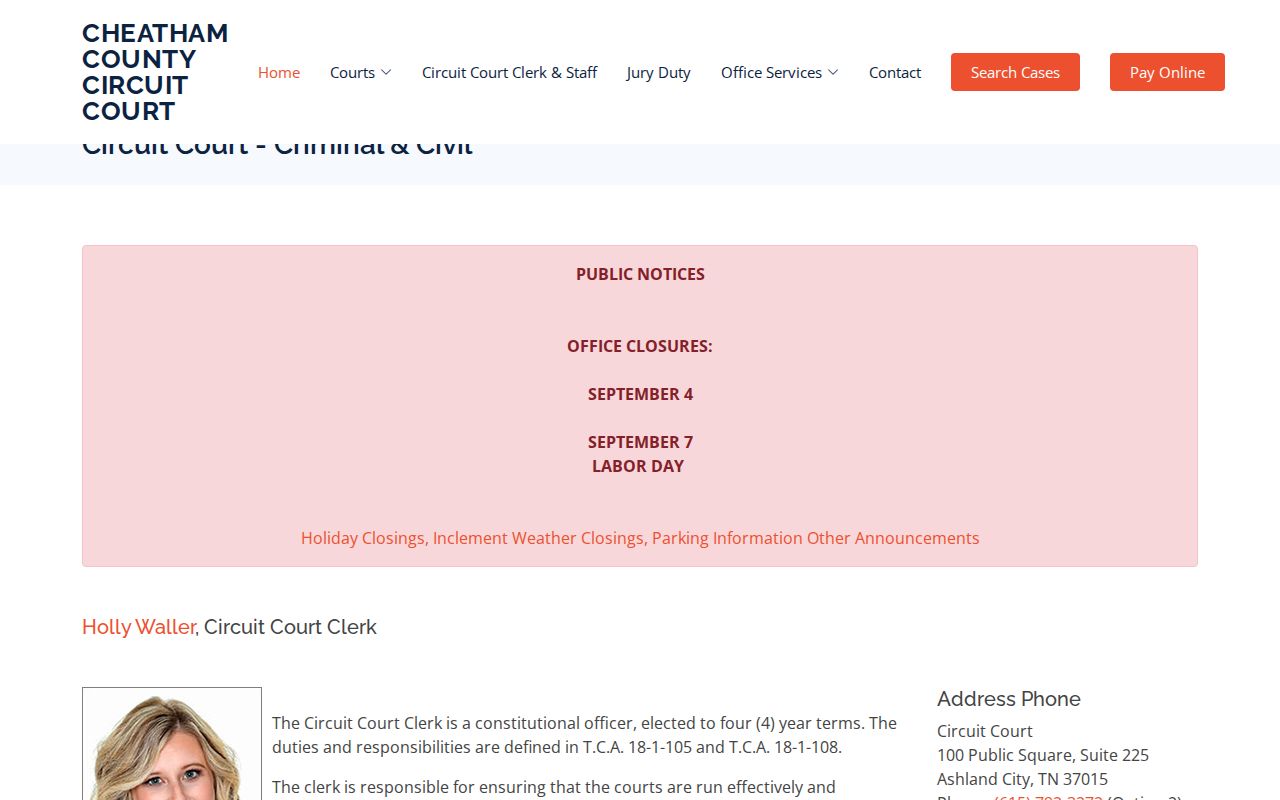
The Circuit Court page lists criminal docket call as typically the second Tuesday of each month at 9:00 a.m. Each judge builds a calendar, and dates move. This office handles grand-jury reports and lower-court appeals. It also handles felonies, misdemeanors, motions, orders, pleadings, petitions, and post-conviction work. The county's official Circuit Court page also states its civil and criminal docket call information.
Treat the published schedule as a planning aid only. The judge's current setting, the docket entry, and clerk confirmation control any particular appearance.
Cheatham County Criminal Docket Courts
General Sessions keeps misdemeanors, felony preliminary hearings, warrants, and county traffic citations on its Criminal Docket. A felony can advance, or a lower-court matter can get appealed. Then the case moves into Cheatham County's Circuit and separate Criminal Court structure within the 23rd Judicial District. Switch the TnCIS court type to Circuit at that point. Do not expect General Sessions to display every later event.
Juvenile matters follow a separate, restricted path. Municipal ordinance and city traffic cases stay in city court unless county jurisdiction applies. A district program or a rotating judge does not turn Cheatham's portal into a five-county docket. It stays a single-county resource.
District 23 Criminal Practice
The 23rd Judicial District local rules give procedural context for Cheatham, Dickson, Houston, Humphreys, and Stewart Counties. They explain how district practice works. Still, the case docket and its orders are what establish what actually happened in a prosecution. The official district source identifies these rules.
Four Circuit Judges rotate through Cheatham in different months. Rotation is context, not a promise about any single setting, so confirm the assigned judge and date with the clerk.
Recovery Court Case Routing
Recovery Court in Cheatham County operates as a General Sessions program. It sits within the 23rd Judicial District. Tennessee's treatment-court contact list names a program contact at 100 Public Square. The public TnCIS screen, though, gives Recovery Court no separate checkbox. You reach it through the ordinary criminal court office.
That routing shapes every lookup. A contact listing proves a referral route exists. It does not create a stand-alone specialty docket database. Program events usually appear inside the underlying criminal case. They rarely appear on a published calendar of their own. So start with the General Sessions criminal selection. Use the party name or case facts printed on the court papers. Then confirm the program setting through the official contact.
Keep the two roles separate. The state contact page can tell a participant where to report. Only the court and the clerk can confirm the filed docket entry, the operative order, and the current public record. For the General Sessions docket and any official copy the public may inspect, ask the Circuit Court Clerk.
Verify Cheatham Criminal Docket Results
Write down what a docket result actually shows. Note the court type, case type, case number, case year, and the date of the event. Need a current hearing, payment balance, or certified judgment? Compare those details with the Circuit Court Clerk. A name match alone proves little. Plenty of people share a name. The result Filter can narrow the visible rows, and clickable headings sort them. Neither tool changes the source data.
Picked the wrong county? Search All Counties can widen the net, though coverage depends on which offices take part. Tennessee Public Case History covers the Supreme Court, the Court of Appeals, and the Court of Criminal Appeals only. It is no substitute for the Cheatham trial docket. Federal criminal cases live in PACER under the Middle District of Tennessee. Keeping those systems straight matters. A failed search is not proof that no record exists.
Know what to request, too. Ask for the docket or register when procedural history is the goal. Ask for a named warrant, order, judgment, or filing when the paper itself is what you need. The register is only an index to court activity. The clerk's official file holds the operative documents. That gap matters after a plea, dismissal, sentence, appeal, or post-conviction filing. A short event label may not explain the full ruling.
Access Rules for Criminal Dockets
Under Tennessee Supreme Court Rule 34, court records are open to inspection unless a law supplies an exception. Sealed or protected files stay off limits. So do internal case-management material, deliberative records, juvenile matters, and expunged items. An empty search result tells you nothing about why. Want to inspect a criminal docket? Phone or visit the Circuit Court Clerk. Ask about mail delivery when needed, and name the court, the case number and year, the document, the date range, and whether you want a plain or certified copy. TnCIS itself warns that its data is not the official record and may be incomplete.
Request route: Cheatham County's TPRA policy excludes the Circuit Court Clerk and Clerk & Master when they hold official court records. Send criminal docket requests to the proper court clerk, not the County Mayor's general records coordinator.